
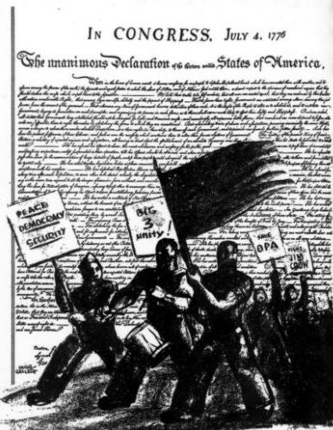
Leninist Analysis of the American Revolution of 1776
Angelo D’Angelo
National Chair, PCUSA
In Comrade Vladimir Lenin’s letter to American workers in 1918, an explanation was set forth for all Marxist-Leninists to factor into our analysis of the July 4th 1776 Revolution.
“The history of modern, civilized America opened with one of those great, really liberating, really revolutionary wars of which there have been so few compared to the vast number of wars of conquest which, like the present imperialist war, were caused by squabbles among kings, landowners or capitalists over the division of usurped lands or ill-gotten gains. That was the war the American people waged against the British robbers who oppressed America and held her in colonial slavery, in the same way as these “civilized” bloodsuckers are still oppressing and holding in colonial slavery hundreds of millions of people in India, Egypt, and all parts of the world.”
- V.I. Lenin, Letter to American Workers, 1918.
This July 4th is the day that we celebrate our independence from the British. While the development from a colony of a monarchy to an independent capitalist democracy was objectively progressive, it’s crucial, now more than ever, to recognize that independence of the country was not independence for all of the nations or classes within that country. Indigenous genocide and Black enslavement constituted the economic and political foundation of our country at its founding and shaped our development.
The subjugation of women has permeated throughout our history and culture, the LGBT+ community has been murdered and oppressed, and the general working class has suffered from the ongoing exploitation and subjugation perpetuated by the capitalists and their reactionary lapdogs. Even though we have made some progress in our development as a country, we still have much more to accomplish. For those who genuinely love their home and their neighbors, we must understand the need for further revolutionary progress; that is, the complete transition of power from the minority of capitalists to the working class which is the majority and the establishment of a socialist state. In spite of the horrors unleashed by our ruling class, the American people have also given rise to the abolitionist movement of the 1800s, the Civil Rights struggle of the 1960s, the anti-imperialist movement during the Vietnam war of the 1970s, and of course, the influential labor rights struggle of both the 1930s and the present period.
The American Revolution of 1776 had an international impact as exemplified by the colonial national liberation war against British imperialism. The Revolutionary War also had an internal domestic aspect exemplified by the popular upsurge against the idea that government could only be derived from a “divine right” to rule under a monarchy. It ushered in the modern era of revolutionary struggles and became the prototype of a whole series of bourgeois-democratic upheavals in Europe and colonial uprisings throughout the world. Today, looking back at Comrade Lenin’s support for the American bourgeois revolution of July 4, 1776, is significant considering the Ultra-Left attacks against the American Revolution. Referring to petty-bourgeois “left” radicals, Comrade Gus Hall correctly analyzed that their attack is basically against the long-standing legacy of Communists who have always served as the working-class patriots of their respective countries.
Our country represents the Marxists idea of a contradiction between having in its entity both oppression and resistance. We’ve achieved national liberation from British imperialism but social revolution is still yet to come. The first revolution was a war of national liberation against the colonizer. The second revolution completed the bourgeois revolution during the Civil War. The third revolution sets forth the task of the party to see to the victory of socialism. In the words of Grenadian revolutionary Maurice Bishop, “Forward ever, backward never.”

