Pages from Our Past: The Treason of Reaction in America’s Second War of Independence
Reactionaries: Their treasonous war in the American War of 1812.
by Frank Meyer and Robert Strong
Originally published in Political Affairs, July 1941
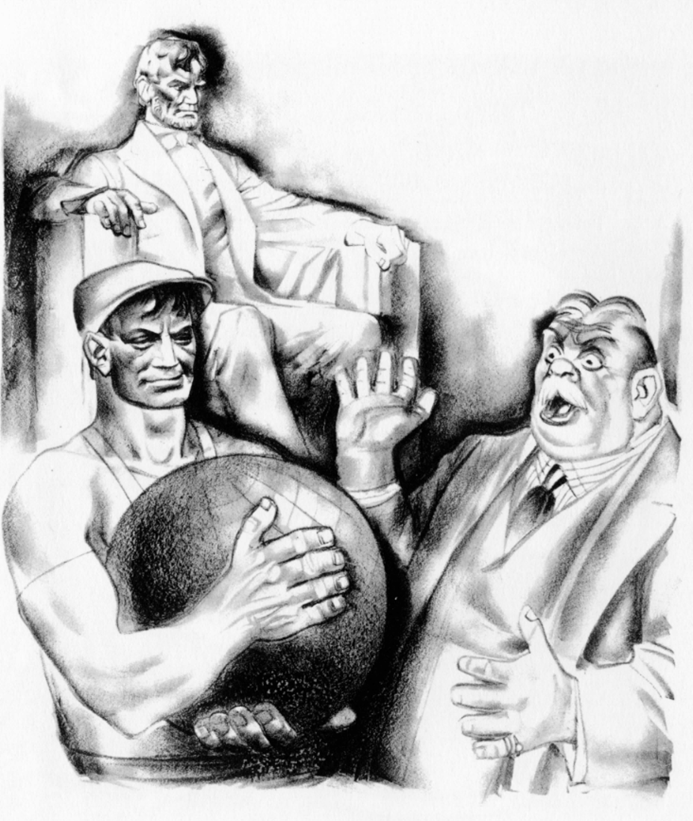
The words of old Abe Lincoln,
Of Jefferson and Paine,
Of Washington and Jackson
And the tasks that still remain.
The history of the period after the victory of the democratic people’s movement under the leadership of Thomas Jefferson in 1800, a period which culminated in the War of 1812, is the history of the completion of the struggle for independence from Britain and against Federalist reaction at home. It is a story rich in material for an understanding of the development of the struggle for democracy—and particularly rich in examples of the degeneracy of those representatives of reaction who are the heroes of the Oliver Wiswell school of history, spawned by decaying American imperialism.
The surrender of Cornwallis at Yorktown signalized the victory of a broad alliance of the American people, of the unity of farmers and artisans, merchants and planters, in the Revolutionary War.
But, independence from Britain once won, a section of this alliance, the aristocratic merchants and bankers, “the rich, the well-born and the able,” as they liked to call themselves, became alarmed at the continuation of the democratic mass movement of the small farmers and artisans; the revolution threatened to go beyond the limits within which its energies could be harnessed to their own selfish class interests. Headed by Alexander Hamilton and John Adams, this commercial aristocracy formed the Federalist Party with the aim of winning control of the national government in order to utilize it further to enrich themselves and increase their power at the expense of the people.
Within the now independent states a new struggle burst forth, whose object was to guarantee and extend the democratic victories won in the revolutionary war with Britain. It was a struggle for extended suffrage, civil liberties, destruction of the remnants of special privilege hanging over from the past, and, above all, free access to the land, the basic means of production of the time.
As Earl Browder has pointed out, summarizing Jefferson’s position:
“Governmental power, political power, can be built only upon a foundation of economic power, that is, ownership, control, and operation of the basic economy of the country, which is the foundation of social life; the America of the late 18th and early 19th centuries was able to achieve such a foundation by breaking up the great colonial land monopolies and opening up the great territories to the West, and by the widespread distribution of free or cheap lands.” (The Democratic Front, Workers Library Publishers, pp. 839-90.)
A New Stage of Struggle
The popular class alliance which had defeated win independence and create the United States now was confronted with treachery from the reactionary Federalist camp. Representing a numerically small, but powerful group of mercantile capitalists, bankers and speculators, the Federalists, to advance their own immediate, narrow, class interests, were ready and eager to betray the national independence and the democratic masses of the U. S. to the British Tories.
Traitors to the American Revolution, they collaborated with Great Britain, which was at that time leading the forces of reaction to butcher the French Revolution and prevent the spread of the bourgeois-democratic revolution in Europe. Today their counterparts of Wall Street and Washington laud Hamilton, condemn Jefferson, and collaborate with imperialism abroad to try and bring about the downfall of the Soviet Union and to crush the developing Socialist and national-liberation revolutions in both hemispheres.
Henceforth, the real national interests of the country, the continuation of the struggle for national independence against Britain, could only be advanced in sharp conflict of the democratic masses against the Federalist camp.
It was Great Britain which still stood in the way of the advance to the West by its maintenance, contrary to the peace treaty, of military posts in the Northwest Territory. It was Britain which encouraged the Indian attacks upon the border and refused, in sphere after sphere, to recognize the full independence of the United States. The struggle against Federalist mercantile reaction was part and parcel of this struggle for national independence.
It was the urgent need for land, the control of which they saw as their only guarantee of freedom, which had impelled the great mass of the population, the small farmers, to revolutionary action in 1776, as it was the compelling necessity to expand trade and the nascent manufacture which had moved the merchants. In 1776 the interests of both these groups, the commercial bourgeoisie and the petty commodity producers, the petty bourgeoisie, demanded a struggle for national independence, a struggle to which their potential mutual antagonism was largely subordinated.
But with the throwing off of the British yoke, this antagonism came to the fore. The development of the United States of America as a nation —the eventual full flowering of its industrial forces of production— demanded expansion Westward. For the country to advance, a broad economy of independent farmers was necessary—the only basis on which the natural resources could be exploited, the home market widened and developed, opening the gates for the growth of manufacture and industry.
In this struggle the democratic farmers and artisans found allies among the Southern planters, particularly among the small and middle planters. The possibility of this alliance arose from certain mutual interests and the common antagonisms to the mercantile aristocracy of the North. The financial policy of the Federalist Party, with its national bank, national debt, and its taxes directed primarily against the agrarian communities, affected the slave-owner as well as the small farmer. Goaded by the exhaustion of the soil after many decades of tobacco cultivation, the land-hungry planters looked to the West, finding common interest with the farmers in opposition to the restrictive land policies of Federalism. Allied with a progressive class, they were often dragged further along in a progressive direction than the narrow consciousness of their own interests would have taken them. At the same time, however, their essentially reactionary class nature made that alliance unstable in character and caused contradictions within it which, particularly in the conduct of the War of 1812, were to have very serious effects. It was from this class, and particularly from among the small plantation owners of the hinterland, that the agrarian democracy received many of its leaders. That so many of the leaders of the democratic movement were themselves slave-owners has made it easier for the great majority of American historians to ignore the fundamental class character of the great mass movement of that period. This is true both of the older writers of the traditional schools and of the “economic determinists” and “muckrakers” of more recent times. These historians have ignored the fact that the driving force of the whole democratic struggle under the leadership of Jefferson was the small commodity producer, the farmer and the artisan. The movement was a democratic people’s movement against reaction at home and abroad.
The Federalist Reaction
The Federalist Party, riding high during the second administration of Washington and the administration of John Adams, made a desperate effort to destroy this growing movement. In domestic policy this was reflected in the Alien and Sedition Acts—the “legal” persecution of the followers of Jefferson as “foreign agents” and “subversive French revolutionaries”’—and the military suppression of the people’s movements, as in the Whiskey Rebellion of 1794 and Fries Rebellion of 1799. Coupled with this was a foreign policy of subservience to the leader of world reaction, England, and bitter hostility to revolutionary France (for example, the notorious “XYZ affair,” an attempt by the Federalist administration to provoke war against France in 1798).
The Victory of the People
But, united under the leadership of Thomas Jefferson, the democratic masses, after ten years of struggle, defeated the new enemy at home. Wresting control of the government from the hands of the Federalists, they elected Jefferson to the Presidency as candidate of the Democratic-Republican Party in 1800.
This victory broke the stranglehold of the reactionary forces upon all branches of the government, except the judiciary, where Marshall and other Federalist judges, secure in posts with life tenure, defied the will of the people. It brought about the revocation of the Alien- and Sedition Acts, the pardoning of the victims of these laws, and the restoration of civil rights to the people. A popular wind swept through the land, bringing a greater measure of democracy into the state and local governments, clearing out to a considerable extent the debris of customs and institutions inherited from the old world, and curtailing the privileges of the so-called “aristocracy of wealth and talents,” the bulwark of the Federalist Party.
Economically, likewise, the measures of the Democratic-Republican administration opened wide the possibilities of ownership of the land by the people—the purchase of Louisiana, which opened the enormous territory between the Mississippi and the Rocky Mountains to American settlement; the land laws of 1800 and 1804, which made much easier the acquisition of land by the small farmer; the Lewis and Clark expedition, which blazed the way for tens of thousands of future settlers from the Ohio to the Pacific. Its financial policies curbed the power of the bankers and merchants of Boston, New York and Philadelphia. It reduced the burden of taxation which had fallen primarily upon the small producers and the consumers—a burden so heavy that it had led to such actions as the Whiskey Rebellion.
On the basis of these democratic policies Jefferson was overwhelmingly re-elected to office in 1804. The Federalists were able to carry only two states—Delaware and Connecticut. Their power was broken. They had lost all popular support and, therewith, all possibility of regaining power through constitutional means. Every year, every month, the democratic forces were strengthened by the growing population of the Western territories and states, with their democratic frontier institutions based upon land ownership by tens of thousands of small farmers. The prosperity of the developing country under Jefferson’s leadership undermined even the old strongholds of Federalism in New England.
The Federalists Turn to Treason
But “the rich, the well-born and the able” could not reconcile themselves to the rule of the people. No longer able to rule within an independent United States, they saw their only hope of regaining power in war and disruption, in the betrayal of the very independence for which they had once fought, in the disintegration of the Union. Opposition to the policies of the people’s movement became their sole guide to action. For example, under Jefferson’s first administration they at one time demanded war against France, which had purchased Louisiana from Spain; a few months later, when Jefferson had succeeded in peacefully obtaining this same territory by purchase from Napoleon, they—the party that had fought for a-“strong national government”—howled that the government had no right to add to the territory of the original Union. Such unprincipled activity only weakened their influence the more. Unable to gain any ground through open political activity, they turned to treasonous intrigue for secession and adherence to Britain. The public activities of the Federalist Party became the mask for conspiracy and were directed solely toward aiding that conspiracy through disrupting and demoralizing the government. In 1804 they were implicated in Aaron Burr’s plot to dismember the United States with the aid of Britain and Spain. Right down to the outbreak of the War of 1812, and throughout its course, they functioned as concealed enemies of the very existence of the American nation. And, like the Trotskyites and Bukharinites in the Soviet Union, unable to find a base for their aims among their own people, they looked abroad for aid; they became the real “foreign agents,” “fifth columnists,” agents of the tyranny and despotism of Britain.
Where else could they look? Like the Trotskyite-Bukharinite conspirators in the Soviet Union, the leadership of the Federalists even lacked confidence in their ability to win the support of what remained of their own camp if they fully revealed their real aims. On March 17, 1804, Stephen Higginson of Massachusetts writes to Timothy Pickering, the leader of the Federalists:
“I have seen your letters to Mr. Cabot and Mr. Lyman on the question of separation. … We all agree that there can be no doubt of its being desirable; but of the expediency of attempting it or discussing it now at this moment, we are all very much in doubt. . . . Many even of our own party have as much yet to unlearn as to learn. They have yet much of the Democratic taint about them; and with this nonsense in their brains . .. we should be put into the background, were we to make that. question the subject of free conversation.” (Henry Adams, [ed.] Documents Relating to New England Federalism, New York, 1878, p. 361.)
In the guarded language of conspiracy, Pickering himself writes to the British Minister, G. H. Rose, on March 13, 1808:
“It also know that … our own best citizens consider the interests of the United States to be interwoven with those of Great Britain, and that our safety depends on hers. Men thus enlightened, could they control the measures of their own government, would give them a direction mutually beneficial to the two nations. Of the opinions and reasonings of such men, I wished you to be possessed.”
possessed.”
This was but one instance in a long history of intrigue with Britain. As far back as 1804 we find Anthony Merry, an earlier British Minister, reporting to the British Foreign Office:
“I am led to believe from the language of some of the members [of Congress] of this State [Massachusetts] that their anxiety on this head is so great [the discussion of a boundary treaty with England]… that the rejection …would… prove to be a great exciting cause to them to go forward rapidly in the steps which they have already commenced toward a separation from the Southern part of the Union… . I learn from members of the Senate that their plans and calculations respecting the event have been long seriously resolved .. . they naturally look forward to Great Britain for support and assistance whenever the occasion shall arrive.” (Henry Adams, History of the United States during the Administrations of Jefferson and Madison, New York, 1930, Vol. II, p. 392.)
In two letters written as far apart as 1803 and 1814, Pickering sums up the treasonable calculations which lay at the base of the activity of the Federalists throughout the period:
“Although the end of all our revolutionary labors and expectations is disappointment [shades of Trotsky! ] and our fond hopes of republican happiness are vanity, and the real patriots of ’76 are overwhelmed by the modern pretenders to that character, I will not yet despair: I will rather anticipate a new Confederacy … there will be—and our children at farthest will see it—a separation.” (Pickering to Richard Peters, Dec. 24, 1803. New England Federalism [cited], p. 338.) Eleven later, Pickering writes to Gouverneur Morris: years “For many years past I have said, ‘Let the ship run aground! The shock will throw the present pilots overboard; and then competent navigators will get her once more afloat, and conduct her safely into port.’” (Adams, History of the United States [cited], Vol. III, p. 210.)
The political principles of this great American “patriot” are summed up in his famous toast— “The world’s last hope—Britain’s fast-anchored isle!”
The International Background
The situation in Europe was highly favorable to the prosecution of these plots against the independence of the United States. Since 1793 England had been almost continuously at war with France, organizing and leading a coalition of every reactionary force in Europe against the French Revolution. In this it had the double aim of checking the democratic movement of the people of France and the rest of the Continent and suppressing the development of France as a new capitalist rival. The French people’s revolutionary army cleared out the native and foreign counter-revolutionaries from the territory of France and, assuming the counteroffensive, toppled over the throne of one feudal ruler after another.
In the desperate fight between France and all the forces of the old regime headed and inspired by the British ruling classes, Jefferson’s policy was directed toward maintaining peace for the United States while at the same time safeguarding America’s independence. This meant, first and foremost, resistance te Britain. For political independence could be guaranteed, and the threat of British domination forever destroyed only by freeing the United States from economic dependence on Britain. The British ruling classes, aristocratic landowners and merchant-capitalists had never become reconciled to the independence of the American nation. As we have shown, they stood in the way of the settlement of the Northwest Territory between the Ohio and Mississippi. They had never recognized the sale of Louisiana by Spain to Napoleon and, therefore, the legality of Jefferson’s purchase of that territory. Hence, they threatened, once the European war was over, to take it from the United States. The existence of British power in Canada, as a base for intrigues among the Indians and as a constant military threat to the entire West, menaced the security of the American farm population.
Alarmed by the threat to their control of world trade from America’s growing commerce, Britain developed the policy which was expressed in the infamous “Orders in Council.” These “Orders” were a series of measures which, in effect, declared that American ships trading with French and Spanish colonies or with the European ports under Napoleon’s control were subject to seizure by the British navy, or, at the very least, to inspection, licensing and the payment of duties to Britain. This policy, while ostensibly inspired by the needs of warfare against France, was unquestionably primarily directed at stifling American trade, and represented an attempt, at one and the same time, to protect the commerce of Britain, reduce the United States to the economic status of a colony, and sow disruption in the United States by convincing the merchants of New England and the middle states that their economic prosperity depended upon subservience to Britain.
Beard’s Interpretation
That this policy was directed primarily against the United States is ignored even by historians who regard the War of 1812 as having been provoked by Great Britain. This is even more true of such historians as Beard, who blur the full progressive significance of the struggle led by the farmers for national independence, and the control of land and trade which guaranteed that independence, by narrowing down that conflict to an immediate selfish interest. They therefore minimize the many-sided attack of Britain on the young United States and accept the British policy at its face value as one whose main purpose was victory over Napoleon. Its effects upon the United States they regard merely more or less “unfortunate” byproducts.
Beard ignores the fact that the very “Orders in Council,” supposedly inspired by the needs of prosecuting the war against France, were in actual fact evaded in a wholesale fashion by British merchants themselves trading with the “blockaded” Continental ports under official British Board of Trade licenses. He seems unaware that the very author of the policy of the “Orders in Council,” James Stephen, clearly stated that the policy was primarily directed at American commerce. Yet it is hard to see how he can be ignorant of this, or of the categorical conclusion of Henry Adams, the greatest authority on the history of the period, who states:
“According to the public and private avowals of all the Ministry, the true object of Perceval’s orders [the Orders in Council] was… to protect British trade from competition. Perceval did not wish to famish France, but to feed her. His object was commercial, not political; his policy aimed at checking the commerce of America in order to stimulate the commerce of England. The pretense that this measure had retaliation for its object and the vindication of international law for its end was a legal fiction, made to meet the objections of America and to help Canning [the British Foreign Secretary] in maintaining a position which he knew to be weak.” (Adams, History of the United States [cited], Vol. IV, p. 101.)
“His [James Stephen’s] speech of March 6, 1809, once more asserted, in language as positive as possible, that the Orders had no other purpose than to stop the American trade with France because it threatened to supplant British trade. The doctrine of retaliation, or the object of retorting evils on France, had nothing to do with Stephen’s scheme.” (Ibid., Vol. V, p. 61.)
It is clear, too, that in addition to the aim of strangling American commerce and subordinating the U. S. to a colonial status, the British ruling class was playing another game, similar, in a sense, to that which it has been playing with small European neutrals in the present war. It was trying to force the United States into a neutral position with regard to Napoleon. The United States was given the choice of resisting England’s decrees or of committing hostile acts against France by accepting them. The position of the United States was by no means made easier by Napoleon, who replied to the Orders in Council with a series of decrees which commanded seizure of American ships complying with the British Orders in Council. These decrees, and the measures taken by Napoleon to enforce them, have enabled such historians as Beard to place equal guilt upon England and France and to ignore the basically different relationship of these countries to American national and democratic interests. Blinded by the fact that American commerce was being attacked both by Napoleon and Great Britain, Beard, always the “economic determinist,” fails completely to see that the independence of the United States and, with it, the most fundamental class and national interests of the mass of the people were directly threatened by England, and not by France.
The Federalists Seize an Opportunity
In the dangerous situation into which the young American republic was thrust in this period, the Federalists saw their opportunity. At every turn and in every way they opposed, legally and illegally, the policies of the Administration. At the same time, they prepared the ground to take advantage of the immobilization and demoralization of American policy, which they themselves were attempting to bring about, for the purpose of destroying the Union and attaching at least a portion of it once again to Great Britain.
Jefferson Policy
Jefferson, expressing the will of the American people, steadfastly directed his policy against the aims of Britain and the Federalists. In implementing his policy, he faced two alternatives—war or economic counter-pressure.
Jefferson was not a pacifist as some historians have asserted. He recognized that, under certain conditions, resistance to tyranny and oppression requires struggle. He wholeheartedly supported the Revolutionary War of 1776. When, at the time of his election in 1800, the Federalist Party tried to deprive the people of the fruits of their victory by a counter-revolutionary putsch, he stated that, if such a plot were attempted, “the middle states will arm” and march on Washington to enforce the will of the majority of the people.
But he feared that war would lead to the enrichment of profiteers and speculators; the impoverishment of the people; the wiping out of a treasury surplus which could be used for public education, for the construction of roads to the west, etc. He felt that satisfaction of the demands of the United States could be wrung from England by economic counter-pressure.
That the series of measures passed by the Democratic-Republican Congresses from 1806 up to the eve of the outbreak of the war were not effective in stopping the attacks upon the United States seems largely due to the fact that they could not be effectively enforced, owing to persistent sabotage by the powerful Federalist banking and mercantile interests.
Beginning with the Non-Importation Act of 1806, which forbade importation of certain British products, but which was not enforced in the hope that its mere passage would cause Britain to give way, the Administration passed on to more stringent action—the Embargo Act of 1807, which forbade all American ships to leave port and barred all American exports to foreign countries.
These measures were directed primarily against England, which was dependent upon such American products as wheat, cotton, beef, pork and lumber, and which, because of her command of the sea, was in a position to prevent American products from reaching France in any case. The repeal of Napoleon’s counter-measures to the British Orders in Council was also an object of this pressure. While the central policy of the administrations of Jefferson and Madison was directed against England, at each stage an attempt was made to take advantage of the antagonism between England and France. This was done either by openly stating or diplomatically hinting that American measures would be withdrawn with regard to that country which first withdrew its restrictive measures.
Sabotage by the Federalists
The embargo, had it been enforced, would have caused great commercial distress in the United States; but it would unquestionably have been a potent weapon against Britain. As it was, every nerve of the Federalists was strained to evade it. Federalist smugglers violated it on every hand. Federalist governors and state officials refused to recognize it. Federalist judges refused to enforce it.
Throwing all pretense of patriotism to the winds, Federalist pamphleteers even supported the British claim to “impress” American seamen, a claim which had recently been put into effect by a British attack upon a United States warship, the Chesapeake, and the slaughter of a number of American sailors in American waters. Pickering openly stated:
“Although Great Britain and her thousands of ships of war could have destroyed our commerce, she has really done us no essential injury.”
His Federalist colleague, John Quincy Adams, Senator from Massachusetts, repudiated this treasonable position of his party:
“Orders once submitted and carried to the extent of their principle would not have left an inch of American canvas upon the ocean but under British license and British taxation.”
The embargo was, however, repealed in 1809. This was due to the combined pressure of the economic distress caused by the embargo, its lack of complete effectiveness due to Federalist sabotage and _propaganda, together with the factional activities of representatives of sections of the Democratic-Republican Party itself.
The embargo was followed by other measures which attempted to bring pressure to bear upon one or another of the belligerents to revise their policy. The administration of Madison, who succeeded Jefferson in 1809, made a series of diplomatic attempts to back up these acts. But the sabotage, which had made the embargo so largely ineffective, was even more successful under these weaker measures.
The Second War of Independence
The only recourse left to the United States was war.
The growing sentiment for war sprang primarily from the new frontier states and the Western sections of the older states, whose population consisted predominantly of small farmers. They realized that the economic power of the merchants and bankers had prevented effective, peaceful resistance to Britain. They suffered economically from the British monopoly of the European market and the depredations on American commerce, which had brought on the depression of 1811-1812, seriously affecting the South and West. They suffered from the threat held over their heads of British-provoked Indian attack, inspired from Britain’s base in Canada. They felt that “the final expulsion of England from the American continent” (as Jefferson put it in a letter to Duane, Aug. 4, 1812) was essential to the safety of the country. At the same time, the possession of the fertile and unsettled land of Canada, so like the Northwest Territory in its suitability to the farming methods to which they were accustomed, seemed equally necessary to economic development. (Likewise, their planter allies saw in Spanish held Florida, with the constant threat of English occupation, a similar danger and a similar opportunity.)
The small farmers, whose class interests coincided with the true national interests of America, demanded a United States really free and independent. They saw in war against Britain the only remaining means of guaranteeing the independence won in 1776 and democratic control of the state and the land, upon ownership of which rested the possibility of political freedom.
“Agricultural Imperialism” or War of Independence?
The narrow bourgeois vision of historians like Beard fails completely to comprehend these basic interests in their fullness. To them, the cause of the war is the “imperialist” desire of the Western farmers to seize Canada, and of the Southern planters to seize Spanish territory to the West and South. They disregard or under-emphasize the significance of Britain’s attack on American independence, all along the line, on land and sea. They regard the British depredations on American commerce, the impressment of American seamen, the driving of American commerce from off the seas, as basically irrelevant to the outbreak of the war. Centering their attention on the merchants, whose immediate interests seemed most directly affected by these depredations, these historians fail to see that the issue of American national existence was involved in these attacks.
Certainly, the merchants, who formed the backbone of the Federalist Party, were actuated by the interests of their class. But those interests which were decisive in determining the policy of that class assumed the expression, first of all, of a desperate struggle to destroy the power of the people, even at the cost of temporary economic sacrifices. The Federalist merchants could carry on their trade with some discomfort under the British flag and the protection of the British navy. What they hated a thousand times more than subservience to the British ruling class was the curbing of their power in the United States by the growing strength of the popular movement.
Speaking on the proposal to admit another Western state, Louisiana, Josiah Quincy, of Massachusetts, stated in the House of Representatives on Jan. 14, 1811 that, if the strength of the people expressed through the Western states was allowed to grow, it would be the occasion for some of the states “to prepare definitely for a separation— amicably if they can, violently if they must.” This is the very language of a later reactionary class, the slave-owners of 1860, when they in turn were faced with the rising power of the progressive classes of their time determined to make an end of the stranglehold of a minority of powerful aristocrats upon the life of the country.
The Federalist merchants were content, so long as the popular progressive forces were defeated, even if it meant victory for Britain. The Chinese of today have a phrase for it: “Running dogs of the imperialists.”
American national interests on the high seas, like the national interests on the Western frontier, found their champion in the small farmers and artisans, whose progressive democratic position made them, at the same time, the vanguard of the nation in its struggle for existence.
Beard’s utter failure to understand the real significance of the war is summed up in the title of the chapter in which the war is discussed, “Agricultural Imperialism”(!)—the “imperialism” of the struggling democracy of the New World directed against “poor little Britain”!
The elections of 1810 returned the so-called “Warhawk” Congress, in which the determination of the farmers to resist the native and foreign conspiracy against the independence of the United States was expressed by such men as John Calhoun of western South Carolina and Henry Clay of Kentucky. (In passing, it is interesting to note that these two men, who in 1810 were spokesmen for the frontier, later, as their regions developed economically, became the spokesmen respectively of the slave-owners and the capitalists against the farmers of the newer frontier, represented by Jacksonian democracy.)
The Federalists Undermine the War Preparations
With the country headed toward war, preparation was imperative. The army had less than 10,000 regulars in addition to the militia of the different states. The navy had no more than half a dozen first-line battleships. Yet, with the certainty of war becoming clearer day by day, measure after measure for adequate preparations was defeated in Congress by the combined vote of the Federalists and factional groups within the Democratic-Republican Party. The Federalists voted for a five-year term of army enlistment because they felt that it would bring about great difficulties in the raising of troops. John Randolph, leader of an anti-administration faction, sabotaged preparedness by lining up Southerners against a provision enabling the President to use the state militias outside the United States boundaries (that is, in Canada). He succeeded in this by taking advantage of the differing interests of the slave-owner and farmer wings of the Democratic Republican Party.[1] Provisions for an adequate tax program and for a navy capable of defending the coasts of the United States were defeated. A combination of the machinations of the Federalists. and the unstable character of the alliance which supported Madison, sabotaged the preparations for war as the embargo had been sabotaged before.
The desperate conspiracy of the Federalists now reached astonishing depths of villainy. The British Minister at Washington, Augustus John Foster, writing to his government on Dec. 11, 1811, reported proposals made to him by responsible Federalist leaders, which showed that they were prepared to go to any lengths to achieve their objective:
“The Federal leaders make no scruples of telling me that they mean to give their votes for war, although they will remain silent in the debates; they add that it will be a short war of six or nine months … telling me that they see no end to restrictions and non-importation laws but in war; that war will turn out the Administration, and then they will have their own way, and make a solid peace with Great Britain.” (Adams, History of the United States [cited], Vol. VI, p. 172.)
On a later occasion Foster writes that on Feb. 1, 1812, two Federalist leaders called upon him to urge the British Government not to make any concessions whatever to the United States, in order that war might be provoked and the Administration thereby defeated.
“The sum of these suggestions,” wrote Foster, “was that we should neither revoke our Orders in Council nor modify them in any manner. They said this Government would, if we conceded, look upon our concessions as being the effect of their own measures, and plume themselves thereon; . . . whereas, if we pushed them to the edge of the precipice by an unbending attitude, that then they must be lost, either by the disgrace of having nearly ruined the trade of the United States and yet failed to reduce Great Britain by their system of commercial restrictions, or else by their incapacity to conduct the government during the war. These gentlemen declared they were for war rather than for the continuance of the restrictory system, even if the war should last four years. . . . In short, they seemed to think that Great Britain could by management bring the United States into any connection with her that she pleased.” (Ibid., p. 174.)
As the election of 1812 approached, the Madison Administration, backed by the farmers and a section of the planters, carried through the declaration of war, which passed the House of Representatives by a vote of 79 to 49. The opposition centered in the representatives of the commercial interests and in the anti-Administration faction led by John Randolph. The war was opposed, not only by the merchants, but also by a section of the planters who formed part of the alliance that had carried Jefferson to power in 1800. Support for the war came mainly from the democratic masses of small farmers.
It is not within the scope of this article to discuss in detail the conduct of the war. Suffice it to say that, throughout the war, the greatest obstacle to its successful prosecution was sabotage and open opposition, particularly in Federalist New England. Federalists in Congress continued to obstruct war measures. Governors of New England states, with the exception of New Hampshire, refused point blank the request of the national government that their states supply their quota of militia. The Governor of Connecticut declared that “the State of Connecticut is a free, sovereign and independent state; that the United States are a confederacy of states,” words to be echoed fifty years later by the representatives of Southern slavocracy. One member of the Massachusetts legislature declared that he would rather have the British constitution, “monarchy and all,” than the American constitution with embargoes.
The financing of the war was deliberately obstructed in Northern financial centers. New England merchants and bankers refused to buy government bonds despite the fact that $10,000,000 out of the country’s total cash, $17,000,000, was in New England. Henry Adams estimates that more New England money was invested in British than in American bonds. Extensive trade was carried on with the enemy; and Great Britain, recognizing the New England merchants as a valuable “fifth column” ally, exempted the coasts of New England from blockade during most of the war. So serious was this trading with the enemy that a British general reporting to England said that two-thirds of his armies in Canada were fed with beef from across the border.
In addition to the sabotage of the Federalist “fifth column,” great difficulties in the prosecution of the war arose from the contradictions within the class alliance supporting Madison. Southern generals had little desire to win victories in Canada which might add non-slave territory to the Union. Besides, the army leadership was filled with incompetent “gentlemen,” many from the ranks of the Southern slaveowners. Of these, the most notorious was Wilkinson, who had been deeply involved in the Burr conspiracy as well as in several other conspiracies against the government of the United States, but who had retained his commission by deserting his confederates each time he found the tide going against him.
In sharp contrast to the attitude of ex-President Jefferson, who never approached a question from the narrow class viewpoint of the Southern slave-owners, the prejudices and activities of political leaders and generals of the South made a victorious expedition into Canada impossible. James Monroe, Secretary of State and acting Secretary of War, urged the peace commission abroad: to sign a treaty with England as soon as possible because he feared that his own armies would conquer Canada. He wrote: “Should our troops enter Canada; you will perceive the effect which success. might have on the public mind here, making it difficult to relinquish territory which had been conquered.” Jefferson wrote, on the other hand, “the cession of Canada. must be a sine qua non of a treaty of peace.”
The Hartford Convention—a Convention of Treason
But the basic responsibility for the ineffectiveness of American arms in the war lay with the Federalists. The climax of their treachery was reached in 1914 when they succeeded in bringing about representatives of five New England states at Hartford. It was the hope of Federalist leaders of the stamp of Pickering that this convention would take steps in the direction of secession.
Though this was the desire of the leaders of Federalists, and though they able to gain a good deal of mass support in New England in opposition to some of the government’s policies, and even to the war itself, they completely lacked real mass support for their fundamental aims. The Hartford convention therefore had to restrict itself to making a series of more moderate demands. It resolved that the states represented should refuse the use of their militia to the national government and oppose conscription; and that each state should take care of its own defense. The convention demanded the passage of a number of amendments to the Constitution, providing, for example, that no new states should be admitted without the agreement of two-thirds of both houses of Congress; the prohibition of all embargoes exceeding days; no interdiction of foreign intercourse or declaration of war without a similar vote; denial to naturalized citizens of the right to hold office in the United States (a continuation of the anti-alien policy of the Adams Administration).
In conclusion, the convention declared that, if the government did not comply with these demands, a new convention should meet and take “such powers and instructions as the exigencies of a crisis so momentous may require.” It was the opinion of advanced Democratic Republicans and of such patriotic Federalists as John Quincy Adams that the actions of the Hartford Convention, short though they fell of the real desires of the leaders, nevertheless constituted an act of treason.
The progress of the war had meanwhile reached a_ stalemate. While in its earlier days America’s privateers and its few naval vessels had achieved great success against the supposedly invincible British fleet, as time passed the greater weight of the British navy made itself felt. On land, the treacherous and incompetent conduct of American generals, together with the activities of the Federalists, led to a series of disasters, culminating in the burning of Washington by British troops.
Nevertheless, it was clear that, even with the aid of their American allies, the British Government could not succeed in conquering the United States, particularly at a time when in England itself a popular movement was taking form against the mercantile-aristocratic combination which had ruled since 1688. After long negotiations a treaty of peace was signed in Ghent on December 24, 1814, a few days before Andrew Jackson crushingly defeated the British troops at New Orleans in the one great American land victory of the war. Here Pakenham’s crack troops were defeated by the frontiersmen, Negro and white, of the South and West. Louisiana was secured once and for all, together with the Port of New Orleans, vital alike to the interests of farmer and planter, the port without which the whole valley of the Ohio and Mississippi could not export their produce economically. Here the dissension between the South and the West, which led to such fiascos as the campaign against Canada, had no foundation, for both were in agreement that New Orleans had to be defended.
The end of the war, together with Jackson’s victory, cut away whatever mass support the Hartford Convention might have had, and the committee of the convention sent to Washington to negotiate with the national government slipped out of the city and was never heard of again.
The treaty of peace, although avoiding explicit settlement of the questions over which the war was fought, nevertheless signalized a decisive victory for American independence and democracy, a conclusive proof that the United States were not only formally, but in actual fact, no colonies of Britain, but “free and independent states.” Louisiana and the entire West were in practice secured for the United States. The American flag achieved full recognition on the high seas. The challenge to Britain’s claims contained in the very declaration of war and the carrying on of armed resistance for two years, irrespective of future disputes on many questions, once and for all established the power of the United States to protect its independence.
At the same time, the successful outcome of the war dealt a death blow to Britain’s most powerful force for the re-colonization of the United States, the Federalist Party; and through their sacrifices and struggles against enemies at home and abroad, the American farmers and their allies finally secured the victory of the American people over British oppression won in the Revolutionary War and over the aristocratic Federalist merchants, bankers and landowners won in 1800.
Within a few years’ time, so complete was this victory, a Democratic-Republican, James Monroe, was elected President of the United States practically unanimously. The Federalists had passed forever from American history, defeated, discredited and despised.
New Alignments
The Embargo and the war, by cutting off European-manufactured goods, had given powerful impetus to the development of industry in the United States, bringing with it the development of new classes— the industrial capitalists and the working class. It is the beginning of a long period of profound class realignment. The policies of Jefferson and the Democratic-Republican Party—based as they were upon the interests of that class which was developing the most advanced forces of production of the time, for the reasons indicated at the outset of this article—of necessity laid the basis for the further development of those forces, for the development of industry.
In fact, as early as the War of 1812, some of the industrial capitalists broke with their mercantile cousins to support the war, though the time was yet far off when their class would lead the coalition of the people against the slavocracy of the South in the second great revolutionary period in American history.
The development of new and more powerful forces of production foreshadowed the end of the leading role of the petty commodity producer. However, allied with the nascent working class, they were to carry forward one more struggle for American democracy when, in the days of Jackson, they fought victoriously against merchant and industrial capitalists on the one hand and their former slave-owner allies on the other. But, with the further development of industry, they necessarily lost their vanguard role.
The great tradition of Jefferson, invoked again at the Chicago Convention of the Republican Party in 1860 in the struggle against the slavocracy, has today passed to the working class as the leading force in the struggle against monopoly capitalism.
The Federalists have had many successors in our history—the slaveowners of 1860, the imperialists of today. The slave-owners went down to defeat before the most advanced class of their time just as the Federalists did and the monopoly capitalists will. And, like the Federalists and slaveowners, the monopoly capitalists will stop at nothing in their desperate effort to prevent that inevitable defeat.
That is why the imperialists today rake up and glorify the worst in the past of our country, and that is why a true understanding of that past becomes a potent weapon in the hands of the people.
In 1812, the progressive development of the United States demanded the successful prosecution of the war against England. The progressive classes of that day, the small farmers and artisans, carried that struggle to a successful conclusion and smashed the party of reaction which stood in their way.
Then, reaction fought against the prosecution of the war because it was a progressive war, a just war, a war of national independence. Today, the forces of reaction are dragging our country more and more deeply into a very different kind of war, a war of imperialist conquest, an unjust, robber war. Today, the American people, with the working class, the leading progressive class of our time, at their head, fights again as in 1812 for progress and freedom. But now that fight demands a struggle against this reactionary war. And as Thomas Jefferson’s party stood in the vanguard then, so the Communist Party, heir to its traditions, leads the way today, certain that now, as then, in the words of Browder, “the people are going to march forward —and to the people will belong the victory.”
[1] One of the considerations weighing heavily with Randolph (a large slave-holder) was fear of the slaves in case of war. This was a considerable factor in developing Federalist sentiment in the South

