
Ultra-Left Adventursim
by Jerry Ginsberg
The State of the Left
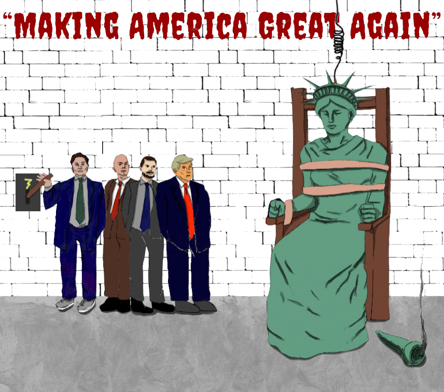
In December 2024, a United Healthcare CEO was assassinated by a lone gunman. Much of the public in America did not react with remorse, but instead shared their frustrations with the state of healthcare in this country; stories of denied claims, expensive bills that cause many families to go into debt, and overall lack of quality care. It is understandable that in the wake of such an act that many Americans would express indifference. The ultra-left, in their typical “super-revolutionary” fashion, proceeded to applaud the vigilante proclaiming that we need to replicate this same scenario for every CEO. In doing so, many so called “communists” and anarchists fall victim to what Gus Hall expresses as “petty-bourgeois radicalism”.
In Gus Hall’s “The Crisis of Petty-Bourgeois Radicalism”, the former CPUSA General Secretary breaks down the logic of the ultra-left:
“Thus the very premise of petty-bourgeois radicalism is that it is impossible to win the working class in the struggle against capitalism. From this it follows that mass concepts of struggle are not possible, necessary or realistic. This leads to actions based on small elite groups––or to individual action. Because this concept is not concerned with winning over masses, it promotes and condones actions that alienate masses. There is an inner logic to this path. Specific actions are taken because there is a lack of confidence in mass–in class–actions. These ill-considered actions result in widening the gap between the petty-bourgeois radical movements and the masses. This widening gap then becomes ‘proof’ that you cannot win masses and therefore the line of conduct of these movements is justified. Each step leads to a further isolation. This is the inner logic of petty-bourgeois radicalism.”[1]
The ultra-left have shown a fetishization with “action” in the form of terrorism that does not progress the working class struggle, but instead hampers it. Their lust for adventurism blinds them to the serious, consistent, and stubborn work that must be done on a daily basis to win the working class over to the side of the Communists.
In America, the surge of individuals towards leftist beliefs began around 2016 when Social-Democrat Bernie Sanders ran for president on a platform calling for many progressive reforms to the healthcare system, transportation, workers’ rights, etc. What naturally happened with his defeat (and the Democrats’ loss to Donald Trump) was a leftward swing among those in the center left. Many were seeking a more concrete solution to society’s ails, which led many to discover Marxism for the first time.
The death of Gus Hall in 2000 left a vacuum in the American Marxist-Leninist camp as the party adopted anti-Sovietism and Social Democratic views. Until the People’s School for Marxist-Leninist Studies formation in 2016 by the Party of Communists USA (PCUSA), there was effectively no party providing a dialectical outlook in the United States. Naturally, this caused many on the left to fall into either the Maoist/Trotskyist or Anarchist tendencies which comprise the bulk of the ultra-left.
While the ultra-left may disagree on issues such as the State, they make up for it in uniting on tactics and their general disdain for any organizing beyond super-revolutionary cliques and slogans. This is evident in Maoists and Anarchists adoption of what Henry Winston would call the “transference of strength”:
“Lenin long ago exposed the anti-Marxist, anarchist nature of such views. In one of his 1902 Iskra articles, Lenin quoted the following from a Socialist Revolutionary leaflet:
“‘Every terrorist blow, as it were, takes away part of the strength of the autocracy and transfers all this strength to the side of the fighters for freedom.’ Such a theory, Lenin said, ‘turns upside down, not only all past experience, but all common sense as well.’ He said further: ‘we know from the past and see in the present that only new forms of the mass movement or the awakening of new sections of the masses to independent struggle really rouses a spirit of struggle and courage in all.’[2]
“As Lenin pointed out, strength cannot be transferred. It develops out of involvement in mass struggle, for which there is no substitute. Mass struggle generates greater and greater unity, strength and consciousness as the science of socialism is more and more closely linked to the struggles by the Party of the working class.”[3]
What we are witnessing is a repeat of mistakes that revolutionaries have already experienced and adapted our theory through scientific process. The ultra-left (Maoists and Trotskyists specifically) claim to be the next “heirs of Lenin” and can’t be bothered to understand his disapproval of economic terrorism, instead fanning away criticism as “liberalism” or no longer applying to the current situation. Their claim that the Marxist-Leninist theory, advanced by Comrades Lenin and Stalin, is no longer applicable is thinly veiled anti-Sovietism wrapped up in revolutionary vigor.
In the 20th Century, the CPUSA was able to withstand right opportunism and ultra-leftism in their theoretical struggle. Led by General Secretary Gus Hall and National Chair Henry Winston, the party gave American Communists an unbreakable foundation to understanding Marxism-Leninism and how it applied to America. Most prominently, the theory of the anti-monopoly coalition led by the working class, which is now at the forefront of the tactics utilized by the PCUSA. In his book, Working Class USA: The Power and the Movement, Hall says:
“Those who would reject the anti-monopoly concept proceed from two lines of argument. The first of these downgrades and discards the democratic struggle, and calls for a ‘pure’ revolutionary strategy —an ‘anti-capitalist’ or ‘anti-imperialist’ strategy. It pits these ‘revolutionary’ strategies against the allegedly ‘non-revolutionary’ anti-monopoly strategy. It is adherence to such a ‘non-revolutionary’ strategy, say these upholders of ‘pure’ revolution, that makes the Party itself a conservative, no longer revolutionary organization. They refuse to see the interrelationship of the democratic anti-monopoly struggle and the revolutionary struggle for socialism.
“Views of this kind distort the attitude of Communists toward the democratic movement. ‘Theoreticians’ of this brand maintain that Communists call for postponing the struggle for socialism until the democratic struggles are won. But this is sheer nonsense. The fact is that the development of the anti-monopoly coalition as a political force is impossible without the development of a powerful Left, without simultaneously advancing the class consciousness of the workers and building a socialist-conscious contingent within their ranks. The very process of radicalization is the necessary foundation for developing the anti-monopoly movement.”[4]
The ultra-left today removes the rich history of the CPUSA and the American Communist movement, opting for theories of national nihilism (“America is a settler colonial state”) and that America is ultimately doomed with no redemption. They see the United States and ultimately the working class of this country as nothing more than “settlers”, who must be sent back to their country of heritage, even those who were born here and have been here for generations. This is not to excuse the history of America, the genocide of the Native Americans, the enslavement of Black people, etc. but the ultra-left have fallen into a trap of attempting to turn back time and right all wrongs by claiming the working class is “labor aristocracy” while glorifying sections of the lumpen-proletariat. In doing so, they continue to capitulate to reactionary forces in this country. The “Make America Great Again” (MAGA) movement in America is one such iteration that uses patriotism and American pride as a tool against the non-white sections of the working class and pushes xenophobic and racist rhetoric, effectively splitting the working class among color lines. The ultra-left commit the same error, instead opting to exclude white workers. In Strategy for a Black Agenda, Henry Winston comments on what he calls a “suicidal skin strategy”:
“Differences in skin color are used by monopoly capital to create and perpetuate division between the white majority and the Black minority in the United States, a division that originated not in differences of skin color, but from a different system—slavery—which was grafted onto the rising capitalist system.
“This different system was the basis for developing the differential in the nature, intensity and character of the special oppression and exploitation of Black people as compared to the white masses.
“But today the Black minority and the white majority are no longer separated by different economic systems. Now only the power of monopoly-fostered racism maintains disunity between Blacks and whites, and perpetuates discrimination against and super-exploitation of the Black minority.”[5]
Ultimately, much of the left today refuse to do the substantial amount of work required to propel the working class into a revolutionary situation required to transition the United States into Socialism. Instead, many have opted to spending hours on social media, creating and dispensing memes proclaiming we need revolution now. The problem compounds when those sharing “revolutionary” propaganda online have no party education, are not cadre in any party, and have a grasp of Marxist theory based only on a small handful of books they have read, but are the ones claiming to have the most accurate positions. This then leads to people who are newer to Marxist theory being exposed solely to ultra-left views as well as driving away those who could be won over, but are now alienated and given a bad impression of the left. The reality is, none of them are to be found on the factory floors, in the trade unions, building working class consciousness and unity. As Gus Hall also said in Petty-Bourgeois Radicalism: “It is a way of keeping a radical image when in fact one has retreated and given up the struggle.”
History of the American Communist Movement
Henry Winston, in Strategy for a Black Agenda addresses one of the greatest crimes of the 20th century, the alliance of the CIA and Maoist groups against their common enemy, the Soviet Union and the working-class movement around the world. The CIA had found the use for these Left-Wing adventurists in order to dismantle an “anti-imperialist, internationalist [working class] strategy with a bourgeois nationalist policy, dividing and thereby weakening the struggle against oppression.” [find from SFBA]
In South Africa, the anti-apartheid movement that was led by the African National Congress (ANC) inspired by Nelson Mandela was set-back due to the reckless, individualistic actions of the separatist Maoist formation of the Pan African Congress (PAC).
The PAC was headed by a South African trade unionist linked with the C.I.A, and had the support of anti-Soviet, Maoist intellectuals like George Padmore. Padmore had the support of the so-called International Free Trade Unions, whose operations were financed by the C.I.A.
With Padmore’s encouragement, this group returned to South Africa, supported by the Chinese Maoists. The group’s first aim was to subvert the ANC’s revolutionary program. The members joined the ANC with the intention to influence it with its separatist, gun-toting, “revolutionary” ideology and organized the Pan-African Congress. The group formally became the PAC as a split off from the African National Congress in 1968.
Winston in “South Africa: Neo-Pan Africanism and Maoism”goes into how the PAC members sabotaged the leadership of the ANC by promoting their adventurist protests in front of police stations in Sharpeville, South Africa:
“The ‘leaders’ of the Pan Africanist Congress, who called the people to the police stations in the name of ‘Congress,’ were serving the apartheid rulers through a strategy directed against the liberation movement. They undermined unity and diverted the people’s forces from a realistic action under conditions of fascist terror, [emphasis ours—Ed.] which the ANC had set to begin the March 31 Anti-Pass National Work stoppage—an action aimed at confronting the regime with the mass unity of the people. By calling upon the people to appear at the fascist police stations, the PAC provocateurs were not only signaling to the fascist regime that the united front of the liberation movement had been breached—in addition, by deceitfully calling this separate action they trapped an unarmed people into a direct confrontation with armed, strong points of South African fascism. Even now [in 1972 when this was written], in the new stage of guerilla warfare led by the African National Congress, this would be sheer adventurism! Clearly, the Sharpeville massacre could not have taken place except as a direct result of the PAC ‘leaders’ splitting of the liberation movement deliberately misleading the people.”[6]
The adventurist’s protest of the PAC put Nelson Mandela and others into prison and impeded the struggle against apartheid. But despite the hindrance of the PAC’s one-day strike in Sharpeville and the massacre that happened afterwards, the ANC was continuing to gain popularity. While the PAC was falling apart due to infighting and disunity within their organizations, the late 70s and 80s marked a turning point for the fight to end the racist regime in South Africa.
Winston mentions that there was a United Front effort that included the armed-resistance against the fascist apartheid coinciding with the peace movement. That was a possibility due to the coordinated effort of the ANC. Winston continues:
“The recent strikes of African workers in mines, factories and on the docks are an historically necessary, revolutionary part of the mobilization of masses for ever-higher levels of struggle for liberation in South Africa. One reason why this mass action takes the form today of direct strikes as compared to the ANC’s stay-away-from-work day—an equally revolutionary tactic in an earlier period—is the difference in the present level of struggle. [emphasis ours—Ed.)
“The strikes are taking place against a background of developing armed struggles led by the African National Congress of South Africa and by organizations of the liberation movements in Rhodesia and Portuguese-occupied areas. The armed struggles are adding to the people’s unity and confidence in all forms of struggle—and intensifying the crisis of white minority rule in South Africa and other countries.
“These armed struggles are directed at the most vulnerable points of fascist rule, while in contrast, when the neo-Pan-African misleaders called upon unarmed people to attack the police strong points, the armed struggle had not even begun.”[7]
What should be apparent by Winston’s analysis is that the PAC wreckers started an isolated struggle prematurely removed from the masses. In contrast, the strategy of the ANC which had the support of the Soviet Union, would lead the struggle from the 60s until the early 90s leading the masses where they were in struggle. The Soviet Union would train thousands of cadres of uMkhonto weSizwe (MK), the armed wing of the ANC, to fight against the apartheid regime to attack the fascist apartheid at its weak points, but along with this, continued non-violent strikes, and the protests to free Nelson Mandela and other ANC leaders was all part of the popular United Democratic Front strategy.
Today, ultra-leftist use similar strategies and tactics that take the form of advocating “instant revolution,” “power out of the barrel of a gun,” “urban guerrilla warfare,” etc. These short-sighted radicals can never gain the support of masses of people. Objectively, their actions allow the ruling imperialists and capitalist leaders to destroy any semblance of solidarity needed to fight against oppression.
American and Anti-Soviet-”Communists”
It is not only the ultra-leftists and Maoists that found interest in the support of the Anti-Soviet groups that claimed to be communists. On the world stage, the U.S. imperialists through the CIA and its shell organizations, found efforts to undermine the anti-imperialists liberation movements led by a working-class coalition. The goal was to secretly cultivate influence, outsource America’s dirty work and undermine the national liberation movements that were progressive and pro-Soviet.
Former US National Security Adviser Zbigniew Brzezinski under Lyndon B Johnson and Jimmy Carter described how he convinced China to support the Khmer Rouge in 1979.
“I encouraged the Chinese to support Pol Pot. Pol Pot was an abomination. We could never support him, but China could.” According to Brzezinski, the USA “winked, semi-publicly” at Chinese and Thai aid to the Khmer Rouge. Well into the 1980s, the United States itself would support the Khmer Rouge against Cambodia’s neighbor and America’s old wartime enemy, the Vietnamese Communists which was supported by the Soviet Union.
Integrated closely into the CIA’s intelligence and psychological warfare units after WWII, organizations, according to the CIA’s own website like the Congress for Cultural Freedom, helped to solidify the CIA’s emerging strategy of promoting the non-Communist left – the strategy that would soon become the theoretical foundation of the agency’s political operations against Communism over the next two decades.
In the case of Afghanistan, handpicked by U.S. administrators to participate in a UNESCO/Columbia University program, Hafizullah Amin was sent to New York in 1957. He later completed a master’s degree at Columbia–coincidentally, at a time when Brzezinski was gaining prominence there as a professor. Later Amin would become General Secretary of the Afghan Communist Party.
Amin would develop an analysis that was nothing but in name Marxist. Rather than pulling a Marxist-Leninist theory of leading a revolution through a labor-led strategy, Amin through his education at Columbia put those responsible for the education of the youth of the country, in the intelligentsia in the seat of the “revolutionary class.” It was through intelligentsia that the ground would gradually be prepared for the revolution, according to Amin’s analysis that he took back to Afghanistan. His revisionist strategy aimed first at the radicalization of Afghan teachers, and through them the radicalization of the Afghan population, especially the rural population. This would gain the support of Maoist China.
While in power, General Secretary Amin’s ultra-leftist tactics were unleashed within the party to liquidate the pro-soviet party members. The agricultural development was hit hard in the rural and religious communities, people were rounded up and detained. Amin deliberately initiated a policy closing mosques which only fueled a growing religious fanaticism that would empower the anti-socialist movement of the Mujahadeen, which included the Taliban and Al-Qaida.
The Soviet Union saw Amin as reckless and denounced his cruel reign. General Secretary Leonid Brezhnev himself told then Afghani President Muhammad Tarekhi in a meeting that the Afghan government must broaden its political base and stop shooting people. Amin would only continue to promote ultra-leftist tactics while demanding the Soviet Union to send troops in the skirmishes it was fighting with CIA and Maoist Chinese-backed radical Islamic groups like the Mujahideen.
Among the many lessons of Afghanistan, the one described here is that ultra-leftist deviations did not develop the proletarian class in the country to lead. The Party was led astray due to Amin’s overemphasis on intellectuals and violent repression of the clergy and peasantry.
Erasure of the American Communist Movement
Much of the theoretical outlook of the ultra-left, besides coming from a petty bourgeois radical view, is disconnected with the broader American Communist movement. The majority of them have not read the likes of Gus Hall and Henry Winston, the CPUSA’s most influential leaders that produced the most consistent Marxist-Leninist world outlook in the United States. In ignoring our history, the ultra-left seek to repeat the mistakes Hall and Winston warned us about. Issues of sectarianism and isolation plague the Maoist and Anarchist circles, making the average American worker unrecognizable to them. One such prominent issue is the two state solution with Israel/Palestine. The ultra-left have sunken to a level of national nihilism that further adds to their isolation, nationally if not globally from the Communist movement. Many now feel the need to call Israel “the Zionist entity”, implying that Israel has always been and will only ever be Zionist and should therefore be destroyed. They applaud Hamas’ actions against any and all Israelis because to the ultra-left, Israelis are nothing but “settlers” from Europe.
Many would be shocked to learn that it was the Soviet Union under Comrade Stalin’s leadership that sought to advocate for the creation of Israel along a two state solution. The CPUSA held the same line on Israel/Palestine, citing Hyman Lumer’s Zionism – Its Role in World Politics and Israel in Crisis by A.B. Magil. The ultra-left intentionally conceal the Communist movement’s historical stance of a two state solution.
“The basis for the coming into being of the State of Israel was not created by Zionism. Until the advent of Hitlerism with its monstrous crimes against the Jews, comparatively few Jews were induced by the Zionists to migrate to Palestine (in 1931 the Jewish population was about 175,000, a little more than one-fourth of the 1946 figure). It was the wave of immigration of refugees during and immediately after the war that first created a substantial Jewish community, and the new wave of immigration from Eastern Europe after 1948, stemming from the horrors of Hitlerism, that swelled the size of this community, doubling its numbers within a few years. But it was the Zionists who retained control and who fashioned the state according to their own design. The validity of Israel’s existence as a state derives from the UN partition resolution. However, the state envisioned by that resolution is not that conceived of and established by Zionism.”[8]
Further erasure of American Communist history is the concept of industrial concentration. Many of the ultra-left, if asked, would profess that the industrial worker are no longer relevant in 2025 as America has sent many manufacturing jobs overseas to foreign countries. The truth is America is still the second highest manufacturing country in the world still, behind China and over double the output from Japan in third. It would be a grave mistake to conclude that industrial workers are no longer the backbone of the American economy. As Gus Hall says in Working Class USA:
“Communists have always pursued a policy of industrial concentration, with special emphasis on the basic section of the industrial working class. Basic industrial workers occupy a special position in the engine room of capitalism, and the system has developed in them a high degree of collectivity and cooperation. For this reason, industrial workers are the most revolutionary section of the working class.”[9]
We’re faced with the age old question from Lenin: what is to be done? The American Communist movement must regain its industrial and working-class base. Historically, Communists have come from within the trade union movement. The vast majority of the American left are not located in the trade unions. As Lenin says, “[Communists] must learn to penetrate into prohibited premises where the representatives of the bourgeoisie are influencing the workers”. This includes methods such as “boring from within” the reactionary trade unions because setting up our own “revolutionary” unions would only further isolate us from the working class. In refusing to do this, the left “cannot hope to win over the majority of the workers”.
On the same premise, American Communists must get involved in bourgeois elections. Of course, elections under the capitalist system have limitations and cannot be looked upon as the end all, be all tactic, which is the line of Social Democrats. Lenin in Left Wing Communism: An Infantile Disorder says, “it has been proved that, far from causing harm to the revolutionary proletariat, participation in a bourgeois-democratic parliament, even a few weeks before the victory of a Soviet republic and even after such a victory, actually helps that proletariat to prove to the backward masses why such parliaments deserve to be done away with”. Yet, much of the American left view bourgeois elections as a waste of time and that willingly participating in it makes one complicit to the continuing of the capitalist system. Such views are born out of the nihilist tendencies within the left and are not of Marxism-Leninism.
Finally, and perhaps the most pressing and important tactic of our generation, promoted by Gus Hall and Henry Winston, is the anti-monopoly coalition. Gus Hall, in Working Class USA, explains, “Anti-monopoly movements do not call for the abolition of the capitalist system, but objectively they are anti-capitalist because they weaken the position and power of the capitalist class and give broad-based support to the issues and struggles of the working class. The movements against monopoly are not in and of themselves for socialism. But objectively they clear the path toward socialism.”
To echo Gus Hall, Americans have a rich history in anti-monopoly struggle. Much of the right-wing use American history to further jingoistic, anti-working class, and counter-revolutionary language when instead the case should be made that events like the American Revolution, which Lenin regarded as “one of those great, really liberating, really revolutionary wars”, inspire the American people to take action against the monopolies.
The American left have a rich history to inspire the working class of this country, regardless of how much the ultra-left deny the revolutionary potential of the industrial proletariat and the working class at large. Instead, the Maoists and Anarchists want to throw all Marxist-Leninist tactics in the “dustbin of history”, viewing them as outdated. On the contrary, the theory of Marxism-Leninism has withstood the attacks of the ultra-left and provides the most concise and correct theoretical outlook for the working class to this day.
“Someone is talking about a one-state solution. If you believe that a one-state solution now is possible, it will be an apartheid state, because Israel has all powers in its hand and they can control all Palestine as they are doing now. And they are committing discrimination policy even against Palestinians inside Israel who are citizens of Israel. You can imagine how they will treat Palestinians in West Bank or in Gaza under the Israeli occupation.
“Someone is talking about a one-state solution. If you believe that a one-state solution now is possible, it will be an apartheid state, because Israel has all powers in its hand and they can control all Palestine as they are doing now. And they are committing discrimination policy even against Palestinians inside Israel who are citizens of Israel. You can imagine how they will treat Palestinians in West Bank or in Gaza under the Israeli occupation.”[10]
[1] Hall, Gus, “The Crisis of Petty-Bourgeois Radicalism”, The Communists, Vol. 2; Party of Communists USA: Seattle, 2022,p. 46.
[2] Lenin, Op. Cit., 1977, pp. 189-191.
[3] Winston, Henry, Selected Works of Henry Winston, Vol. 3; New Outlook Publishers: Seattle, 2024, pp. 173-74.
[4] Hall, Gus, Working Class USA: The Power and the Movement; International Publishers: New York, 1987, pp. 293-94.
[5] Winston, Henry, Strategy for a Black Agenda; International Publishers: New York, 1973, p. 18.
[6] Winston, Henry, “South Africa: Neo-Pan Africanism and Maoism” in Selected Works of Henry Winston, Vol. 3; New Outlook Publishers: Seattle, 2025, pp. 233-34.
[7]Ibid., p. 238.
[8] Lumer, Hyman, Zionism – Its Role in World Politics; New Outlook Publishers: Seattle, 2024, pg. 11.
[9] Hall, Op. Cit., 1987, p. 59.
[10] Taqaz, Dr. Aqel, “Palestinian Communist Leader Dr. Aqel Taqaz Supports Two-State Solution”, The Daily Worker.

